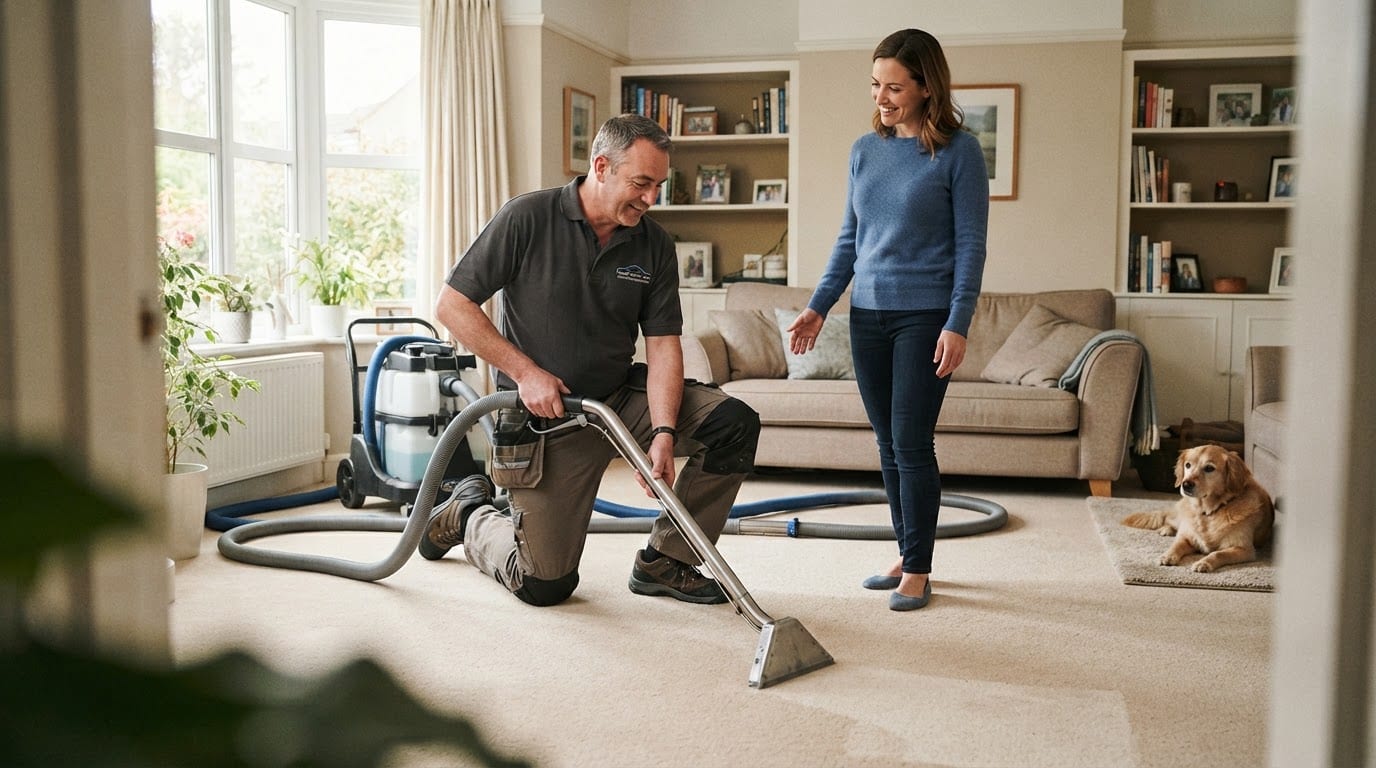
A carpet that looks dull after a year of family life, or smells faintly after a pet accident, rarely gets fixed by simply booking the first firm that appears in a search. The difference between a good result and a disappointing one usually comes down to the method used, the products applied, how the job is priced, and whether the provider is honest about what can and cannot be removed. Knowing what to check before you book saves money and avoids a carpet that stays damp for days or keeps its stain.
Searches for best carpet cleaning near me tend to return a mix of directories, lead-generation sites, and individual trader pages, which makes it hard to tell which businesses are established locally and which are simply well marketed. The aim of this guide is to help you separate the two. It covers how to judge local credibility, what a fair quote should include, how cleaning methods and drying times differ, how to handle chemicals around children and pets, and how often different households actually need a professional clean.
Finding a provider nearby is a sensible starting point, but proximity is only one part of the decision. Local firms vary widely in experience, insurance, and pricing, and a company that has served your area for a decade may be a better choice than one that happens to be a few streets closer. Many customers searching in London, for example, will find firms such as T&M Cleaning Services listed alongside dozens of others, and the same checklist applies to all of them.
Reading Local Credibility Beyond Distance
Proximity alone does not predict quality. A van parked two streets away tells you very little about how the cleaner handles a wool rug or whether the operator carries adequate cover if something goes wrong. More useful local signals include:
-
Time operating in the area. A firm that has worked the same boroughs or towns for many years has a track record you can verify through reviews and local references.
-
Insurance. Ask for proof of public liability insurance. Damage to furniture, flooring, or fittings during a clean is uncommon but not unheard of, and insured firms can resolve these claims properly.
-
Trade body membership. Bodies such as TACCA (The Approved Carpet Cleaning Alliance) set technical and conduct standards for members. Membership is not a guarantee of quality, but it gives you a body to complain to if the work falls short. For water-damage work, check whether the firm follows the IICRC S500 standard, which governs professional water extraction and drying.
Spotting Review Patterns Worth Trusting
Reviews are most useful when read critically. Favour recent feedback over a large cluster of older reviews, since staff and methods change. Look for specific detail: a mention of a red wine stain on a particular sofa, a pet urine problem in a hallway, or a rug that had been cleaned before without success carries more weight than “great service.”
Compare one-line praise with fuller accounts. A review that describes how the cleaner pre-treated stains, how long the carpet took to dry, and whether the appointment started on time gives you evidence about process. “Excellent, thanks” gives you almost nothing.
Flag reviews that describe a clear before-and-after outcome or explain what the cleaner did differently. A reviewer who says the cleaner used a longer pre-spray dwell time and then extracted twice has described technique, which suggests the firm understands the job. Also read how the business responds to complaints. A calm, specific reply that offers a return visit is a better sign than a row of five-star reviews with no negative ones at all, which can indicate selective publishing.
Checking You Are Actually Covered
Many firms advertise coverage across wide regions but serve only certain boroughs or towns regularly. Check the postcode directly against the provider’s service area and ask whether they attend your specific postcode on a standard booking, not just as an occasional exception. Ask about travel charges, and whether they will confirm coverage before you pay a deposit.
What a Fair Quote Should Actually Cover
Carpet cleaning is priced by a combination of factors rather than a flat rate. The main drivers are the number and size of rooms, the carpet type and pile, the level of foot traffic, and how heavily soiled or stained the carpet is. A heavily worn hallway runner with pet residue requires more pre-treatment, more time, and often more solution than a lightly used bedroom carpet.
Benchmarks are useful but should be treated with caution. Birmingham directory data, for example, shows typical quotes for common jobs ranging from roughly £90 to £150 for a standard room and from about £140 to £265 for larger or more involved jobs. London pricing tends to sit at the upper end of those ranges. A single average can mislead, however, because a three-bedroom family home with two dogs and a long landing will differ enormously from a one-bedroom flat with a single lounge carpet. Use ranges to spot quotes that are implausibly low, not as a fixed target.
When comparing quotes, check each line item:
-
Pre-treatment: Is pre-spraying and stain treatment included, and for how many stains?
-
Stain work: Is specialist treatment for pet, wine, or coffee marks priced separately?
-
Deodoriser: Is a deodoriser applied, and is it a neutraliser or a fragrance?
-
Furniture moving: Are light items moved as standard, and are heavier pieces excluded?
-
VAT: Is the quote inclusive or exclusive of VAT, and is any VAT added at invoice?
-
Parking or congestion charges: Are these included? In central London, the Congestion Charge applies to vehicles entering the zone during charging hours, so ask whether it is absorbed or passed on.
-
Travel: Is travel included within your area, or charged by distance?
Re-cleans and Satisfaction Guarantees
A re-clean or satisfaction guarantee should specify what it covers and for how long. A typical policy requires you to report a problem within a set window, often 48 hours, after which the firm returns at no extra cost to re-treat the affected area. Ask what happens if a stain does not lift. A reputable provider will say that some marks cannot be fully removed, explain why, and tell you the result before work starts rather than promising an outcome they cannot deliver.
Method, Drying Time, and Planning Around the Clean
Steam Versus Dry Cleaning
Steam cleaning, technically hot water extraction (HWE), injects heated water and cleaning solution into the carpet pile and then extracts it along with dissolved soil. It suits most domestic carpets, particularly synthetic and wool-blend fibres, and it removes deep-set dirt effectively. Its drawback is moisture: the carpet and underlay must dry before use.
Dry or low-moisture methods use compounds, bonnet pads, or encapsulating chemicals that crystallise soil so it can be vacuumed away. These suit carpets that cannot tolerate water, some hand-made or delicate rugs, and situations where the room must be used within hours. They generally clean less deeply than HWE and are less effective on heavily soiled traffic lanes.
Both methods can produce good results. The choice depends on the carpet’s construction, its condition, and how quickly you need to walk on it.
Why Drying Times Vary
Sources give different drying ranges, and the variation is real. London providers commonly quote touch-dry times of two to four hours after hot water extraction. Other firms cite three to six hours, and directory guidance for Birmingham suggests four to six hours, with up to 24 hours for thicker carpets or specialist treatments.
Drying time depends on:
-
Ventilation: Open windows and working extraction fans reduce drying time significantly.
-
Room temperature: A warm room speeds evaporation. In winter, a cold or unheated room can extend drying considerably.
-
Carpet thickness and underlay: Dense pile and thick foam or felt underlay hold more water.
-
Water volume: Over-wetting, often caused by too much solution or inadequate extraction passes, is the main reason a carpet stays damp.
Ask the cleaner how many extraction passes they plan and what moisture levels they aim for before leaving the room.
Planning the Day
Good preparation shortens the job and improves the result:
-
Clear small items, toys, and loose cables from the floor.
-
Keep pets off the carpet until it is fully dry, and shut them out of the room during the clean.
-
Arrange access, including parking, key handover, and whether the cleaner needs power.
-
Avoid booking immediately before guests arrive or a move-in date. Allow a full day for drying in a typical home, and more for thick or heavily soiled carpets.
Chemicals, Pets, Children, and Honest Stain Expectations
What “Eco-Friendly” and “Non-Toxic” Actually Mean
In the UK, terms such as “eco-friendly” and “non-toxic” are marketing descriptions rather than a single regulated standard. A product may be biodegradable, low in volatile organic compounds, or fragrance-free, yet still require careful handling. Ask the provider for the product name and its safety data sheet, and ask how they handle chemical storage and use in line with COSHH (Control of Substances Hazardous to Health) requirements. Useful questions include:
-
Are the products suitable for use around children and pets once dry?
-
How long should the room be kept closed after treatment?
-
Do you use an alkaline pre-spray, and does it need rinsing?
-
Is the deodoriser a neutraliser or a scent?
Some carpets, particularly wool, may react poorly to strongly alkaline or unsuitable products, so ask whether the cleaner tests a hidden area first.
Odour Removal Versus Masking
Masking hides a smell with fragrance. Odour removal breaks down the compounds causing it. The distinction matters with pet urine, which contains uric acid and related compounds that bond to carpet fibres and underlay. Simple cleaning often removes surface residue, but the source can keep releasing odour, especially in humidity.
Pet accidents usually need enzymatic treatment, which uses biological agents to break down the organic residue. A technician may use a UV torch to locate old urine, which fluoresces under ultraviolet light, and may need to treat the underlay or, in severe cases, the subfloor. If a smell returns a few days after cleaning, the source has not been fully treated.
Pet Accidents and Lingering Smells
Pet stains often need more than a standard clean because urine penetrates deeper than most household spills and can discolour fibres. Tell the provider about pet accidents when you book, including how old the marks are, whether they have been treated before, and where they are located. This lets the firm bring the right pre-treatment and set realistic expectations.
Honest Stain Expectations
Not every mark will lift. Very old stains, bleach damage, and certain dyes, particularly on natural fibres or dyed rugs, may be permanent whoever cleans them. A trustworthy provider will say so before starting, not after. Ask for a clear statement of likely outcomes for specific marks, and check whether they will photograph the carpet before and after treatment.
Cleaning Frequency and Urgent or Specialist Jobs
Recommended frequency depends on household circumstances rather than a fixed rule:
-
Quiet home with no pets or children: Once a year is generally enough to keep the carpet fresh and maintain its appearance.
-
Households with children, pets, or allergy sufferers: Every six months is more realistic. Allergens and pet dander accumulate in fibres and underlay, so frequent vacuuming alongside professional cleaning helps.
-
High-traffic hallways and stairs: These may need attention every three to six months, depending on footwear and wear patterns.
-
Offices and rental properties: These often need cleaning more frequently, sometimes quarterly, to meet occupancy and landlord standards.
Time-Sensitive Jobs
End-of-tenancy cleans are often required to meet letting agent or landlord standards, so book early and confirm the exact inventory requirements. Ask whether the provider will issue a certificate or report, as some agents request one.
Same-day spills, pet accidents, and water damage need faster response. For water damage, ask whether the firm uses industrial extraction equipment and dehumidifiers, and whether it follows the IICRC S500 drying standard. Clarify whether out-of-hours or emergency callouts carry a surcharge, what the response time is in your area, and whether same-day availability is guaranteed or subject to capacity.
Choosing a local carpet cleaner is less about finding the nearest name and more about checking evidence: verifiable experience, insurance, honest quotes, a clear method, and a candid view of what can be removed. Ask the questions above before you book, and a good provider will answer them without hesitation.
