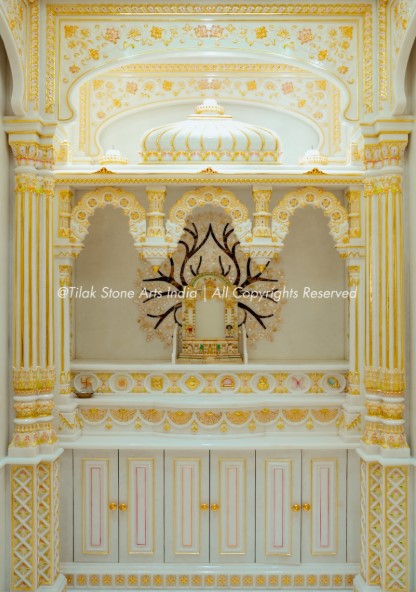
The stone chosen for a home temple decides how fine its carving can go and how much care it needs. Vietnam white marble suits the temple itself, and onyx or Wonder White belong on the pooja room walls around it.
Two temples can follow the same drawing and still look nothing alike once installed. Stone explains the gap. It decides how deep a carver can safely cut, and how the surface behaves after years of puja. Get it right and a stone mandir for home looks settled from the start and stays that way.
The Stone Decides before the Chisel Does
Carving Depth Depends on Density: Soft or brittle stone forces a carver to keep motifs shallow, because deeper cuts risk a crack running through a petal. A properly made stone mandir for home uses dense white marble, so the carver can undercut leaves and pierce small openings in the arch. Those shadows give the carving depth from across the room.
Upkeep Starts at the Workshop: Marble soaks up colour, and a pooja corner handles haldi and kumkum every day. A yellow mark left overnight can settle in for good. Thorough white marble temple suppliers apply a penetrating sealer before dispatch and tell you which cleaners are safe. Plain water and a soft cloth cover most days, with a pH-neutral cleaner weekly.
White for the Temple, Other Stones for the Room
Brightness That Holds under Lamp Light: Vietnam white marble has a bright, milky base with very little veining, so carved faces read cleanly instead of fighting a grey streak. It polishes to a high shine and holds it on steps you touch daily. Its density helps too. Hindu rituals bring water and lamp smoke close to the stone, and dense marble copes better.
Supporting Stones for Floors and Walls: Specialist white marble temple suppliers keep the temple in Vietnam white and use other stones around it. Wonder White, an Indian marble, works well on pooja room floors. Italian varieties bring bolder veining to a feature wall. Onyx lets light pass through, so it makes a fine backlit panel, though it scratches easily and belongs away from busy hands.
Natural Shade Shifts and the Mark of a Hand
Reading Shade and Finish before You Approve: Natural marble varies in shade between blocks. Vietnam white can lean cool or drift towards a faint cream, and that lean should sit well with the colour palette of your walls and woodwork. Polished surfaces bounce light around, while a matt finish feels calmer up close. Check these points when samples arrive.
- Samples from your actual block, seen in daylight
- Matching finish on temple and steps
- Faint chisel marks deep in the petals, a sign of hand finishing
- No dark vein crossing a carved face
Workshops That Sort Stone by Purpose: Workshops whose designers specialise in mandirs read the stone as closely as the pattern. They decide which part of a block becomes the pillars and which part takes the finest carving. A custom stone mandir for home built this way can come with matching offcuts set aside, so if a corner chips years later, the repair blends in.
Stone You Will Be Glad You Chose
Ask your shortlisted supplier for two small polished samples: the Vietnam white for the temple and whichever stone you like for the walls. Keep them in your pooja corner for a few days. Leave a pinch of haldi on one corner overnight, then wipe it. How each sample cleans up will tell you plenty.
