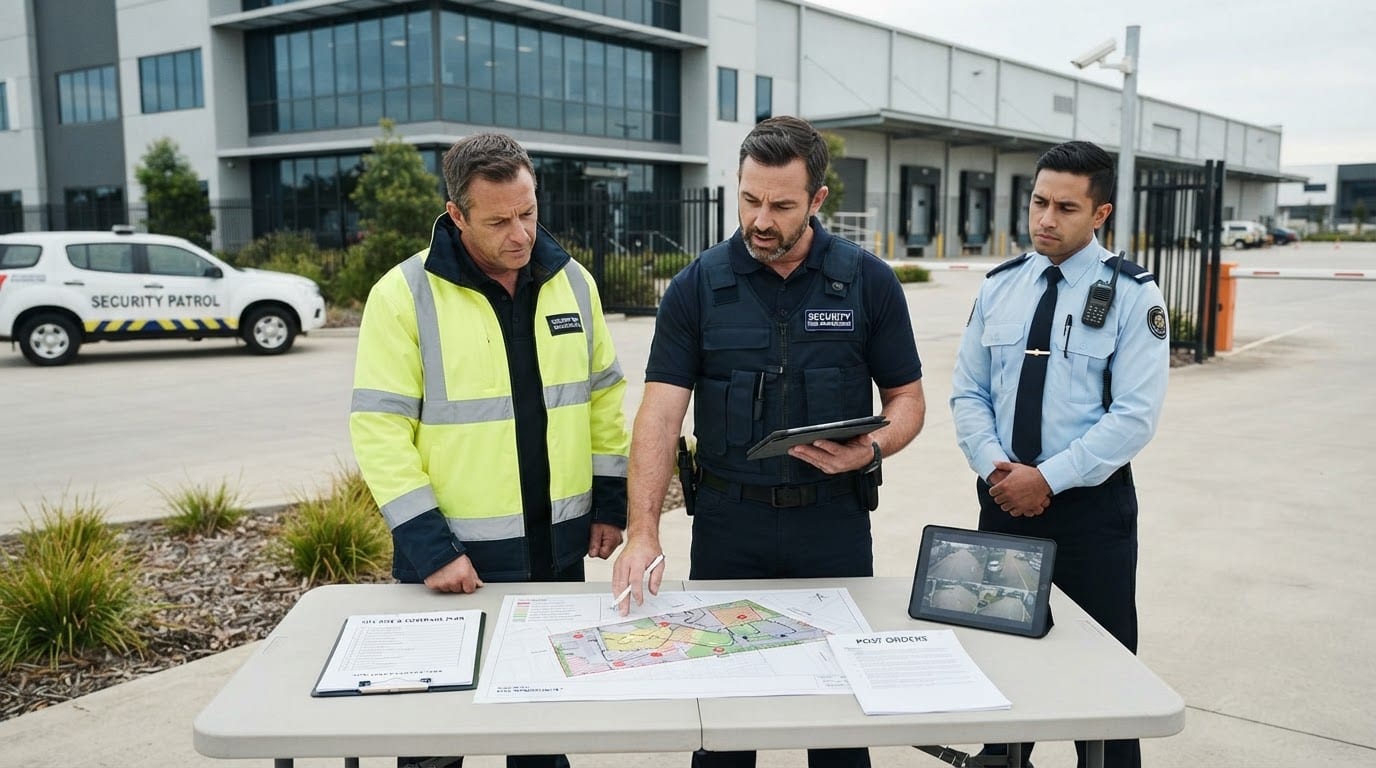
A warehouse manager in an industrial park may pay for an overnight guard who spends most of each shift at a desk near the main gate, while thefts happen at the rear fence line where no one is looking. The problem is rarely the guard’s effort. It is that the coverage was never built around where and when losses actually occur.
Before comparing quotes from a guard security service, property owners benefit from defining three things: what they are protecting against, when that risk peaks, and what evidence they will use to judge whether the staffing is working. Those answers determine the deployment model, the contract structure, and the performance metrics, so they should come first.
Security staffing is often bought as a package because packages are easy to compare. Yet two sites with identical square footage can need very different guard behavior. A distribution center that loses inventory during shift changes, a medical office that struggles with after-hours visitors, and a construction yard with recurring copper theft each face different threats. Treating them as interchangeable leads to paying for visibility where prevention requires control, or for patrols where a fixed post would screen people more effectively.
Start With the Risk Your Site Actually Faces
Coverage should follow the threat profile. Start by separating the main categories of loss and disturbance, because each calls for different guard actions:
- Theft: Requires attention to loading docks, storage areas, and inventory movement, along with documented checks of restricted zones.
- Trespassing: Calls for perimeter checks, clear authority to challenge or remove unauthorized persons, and coordination with local police for repeat entry.
- Vandalism: Often concentrated in parking areas, rear walls, and unlit corners, where timed patrols and incident photos matter more than a stationary presence.
- Workplace violence: Demands guards trained in de-escalation, defined reporting chains, and coordination with HR and management on threat assessments.
- After-hours access: Requires badge verification, key control checks, and a procedure for handling unscheduled entries by employees or contractors.
Review your own records before requesting quotes. Incident logs, insurance claim histories, and police reports reveal patterns that a sales consultant may not know. If most claims involve losses discovered on Monday mornings, the gap is likely weekend coverage rather than daytime staffing. Pull at least 24 months of data where possible, and note the time, location, and type of each event.
Risk also shifts with time, season, and occupancy. A retail lot may face its highest exposure in the hour after closing, when staff are leaving and cash handling is ending. A warehouse may be most vulnerable during shift changes, when access points are busy and attention is divided. Seasonal factors matter too. In hurricane-prone coastal regions, property owners often need staffing plans for pre-storm securing, post-storm damage patrols, and the period when power outages disable alarms. Heat in southern markets can also affect guard scheduling, since longer outdoor patrols require rest breaks and hydration planning.
Local crime data is useful context but should not be treated as a verdict. Neighborhood statistics describe an area, not a specific building. A property with strong lighting, controlled access, and low historical losses may need less staffing than a poorly lit site two blocks away with a higher reported crime rate.
Fixed Posts, Roving Patrols, or Mobile Checks: Choosing the Coverage Model
Each deployment model accomplishes something different, so the choice should follow the risk rather than habit.
When a Stationed Guard Makes Sense
A fixed post is most effective where a person must control movement. Lobbies, controlled access points, and high-value rooms benefit from a visible presence that deters and screens visitors. A stationed guard can verify identification, enforce sign-in logs, check badges, and manage escort procedures for contractors or vendors.
Fixed posts are also appropriate where the guard’s role involves decisions that require a fixed location, such as monitoring a camera wall, operating a gate, or managing a loading dock schedule. The cost is higher per hour, and a single post cannot cover multiple areas at once, so it works best where the threat is concentrated.
When Patrols Outperform a Post
Roving patrols suit large, multi-building, or open-perimeter sites such as construction yards, parking structures, and industrial lots. A single guard at a gate cannot see the back of a 40-acre yard. A patrol officer on a timed route can check fences, gates, storage containers, and equipment lots at intervals that discourage prolonged access.
The value of patrols lies in documentation. Checkpoint logging, using either electronic guard tour systems or handheld readers, creates verifiable evidence that specific locations were visited at specific times. Routes should be timed to avoid predictable patterns, and post orders should specify how many checkpoints must be completed per shift. Mobile checks, where a vehicle-based officer responds to alarms or completes periodic inspections, can cover multiple sites at a lower hourly cost, though response times will be longer than those of a stationed guard.
Writing Post Orders and Verifying Provider Credentials
Shift attention from what to buy to how to hold a provider accountable. Post orders are the core operational document. They are written instructions that define the guard’s duties, escalation steps, emergency contacts, and the actions the guard may and may not take. A well-drafted order states, for example, that the officer must not detain individuals beyond the authority granted by the property owner and local law, and must call police for any confrontation involving a weapon.
Ask the provider who drafts post orders, how often they are revised, and whether the client signs off on them. Post orders should be reviewed after any significant incident, after changes to the site layout, and at least annually. Signed copies should be kept on site, since guards who cannot access instructions cannot follow them.
Credential verification is equally important. Confirm that the provider holds the required state license and check it directly in the official licensing database maintained by the state regulator. Licensing rules vary by state, and some require separate registrations for armed positions, firearms training, and use-of-force certification. Request a current certificate of general liability insurance, and confirm workers’ compensation coverage and surety bonding status, since uninsured subcontractors can shift liability back to the client.
Clarify whether guards are employees or subcontractors. Employee-based providers generally offer more control over training and turnover, while subcontracted officers may be harder to supervise consistently. If armed positions are proposed, ask which permits, firearms qualifications, and recertification intervals apply under state law.
Finally, ask about background screening, training hours, and turnover. Turnover rates above roughly 50 percent annually often signal inconsistent post performance, since site knowledge takes time to develop. Ask for training records that include certifications such as OSHA 10-Hour General Industry, first aid and CPR, and any state-mandated security officer courses. Marketing claims about being highly trained are less useful than these records.
Reading the Contract: Pricing Structure and Hidden Cost Drivers
Guard pricing typically follows one of three structures. Hourly billing suits sites with variable schedules or irregular demand. Flat monthly rates fit fixed posts with predictable hours. Per-event pricing applies to temporary needs such as construction milestones or special events. As a rough benchmark, unarmed officer rates in many US metropolitan markets have ranged from about $25 to $50 per hour in recent years, with armed officers and supervisors billed higher. Rates vary substantially by region, labor market, and contract volume, so treat these figures as planning ranges rather than quotes.
Hidden costs usually appear in the fine print. Check for:
- Minimum billing hours: Some contracts charge for a four-hour minimum even when a call-out lasts less time.
- Overtime and holiday premiums: Overtime is often billed at 1.5 times the base rate, and holidays may carry higher multipliers.
- Supervisor visits: Some providers bill supervisory inspections separately, which can add meaningful cost on multi-site contracts.
- Equipment charges: Radios, guard tour devices, body cameras, and vehicles may be billed as add-ons.
- Travel and mileage: Mobile patrols across dispersed sites may generate separate charges.
Review term length, early termination penalties, and notice requirements. Month-to-month arrangements provide flexibility but may cost more per hour. Multi-year contracts can reduce rates but may lock in staffing levels that no longer match the risk after a site changes.
Written service levels are essential. Look for defined response times to alarms or calls, reporting deadlines for incident reports, the required format for those reports, and the procedure for replacing a guard who calls out sick. A contract that promises "rapid response" without a time standard gives the client little recourse when performance falls short.
Confirm how the provider handles liability limits and damage caused by its personnel. Standard agreements often limit liability to a multiple of monthly fees, which may be far below the value of a loss. Ask whether the provider carries umbrella coverage and whether it indemnifies the client for property damage or injury caused by its officers.
Evaluating Performance After Deployment
Most guides end at the signature, but staffing performance is determined in the months that follow. Set baseline metrics before the contract starts. Useful measures include incident counts by category, average response time to alarms, patrol completion rates against checkpoint targets, and the number of post order violations identified in audits.
Review activity logs and incident reports on a regular schedule, weekly at first and monthly once the pattern stabilizes. Compare them against post orders. A guard who logs every checkpoint but never records a visitor interaction may be completing patrols without observing the site, while a log filled with minor entries may indicate the officer is missing more significant events.
Plan a formal coverage review at 60 to 90 days. At that point, enough data exists to adjust hours, posts, or patrol routes. A site that shows losses concentrated in a two-hour window may justify shifting a patrol. A post that records almost no activity for six weeks may be a candidate for reduction or conversion to mobile checks.
Pair guards with physical measures. Lighting upgrades, access control hardware, and camera coverage can reduce the need for staffing. Conversely, if gaps in those systems persist, such as cameras that fail after dark or doors propped open during deliveries, guard demand may be masking a technology problem. Assess whether staffing requests are compensating for gaps that could be closed more cost-effectively with fixed improvements.
The strongest security programs treat the guard contract as a living arrangement. Risk changes with tenants, construction phases, and neighborhood conditions. Coverage that is reviewed against evidence, documented in post orders, and adjusted on a schedule is more likely to match the actual threat than a package selected once and left unexamined.
