
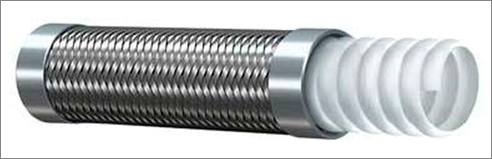
A quick-release coupling joins a flexible hose to a machine, a tank, or another line without using any tools. You press, twist, or pull a sleeve, and the connection locks or frees in a second. That speed matters on a busy site, where a worker might swap lines many times in one shift. So the pairing of a quick-release coupling and a flexible hose has to be right. Get it wrong, and you lose pressure, or worse a complete breakdown.
Here is why the match matters. A flexible hose carries fluid, gas, or compressed air, often under high pressure. The quick-release coupling sits at each end and holds that pressure in. If the two parts carry different ratings, the seal can fail. It might leak slowly, as a drip, or let go all at once.
How a Quick-Release Coupling Locks Onto a Flexible Hose
A coupling comes in two halves. One sits on the hose end, and the other on the equipment or a second line. Inside the female half, small steel balls or a spring sleeve grip a groove on the male half. When the two sit together, they lock. A rubber seal, usually an O-ring, sits between them and stops leaks. Some couplings add a valve that shuts the moment you disconnect, which keeps the line from draining across the floor. That feature suits hydraulic work, where oil stays under pressure even after the machine stops.
Quick Release Coupling Versus a Permanent Fitting
A bolted or crimped fitting holds well and rarely leaks, but it stays put. You need tools and time to break it. A quick-release coupling trades a little of that strength for speed, which is a fair swap on a line that comes apart often. Plenty of plants run both fixed fittings on the static runs and quick release on everything that moves. On a hose that never moves, a permanent fitting is probably the better call. The choice is less about which one is stronger and more about how often the connection has to change.
Matching the Coupling to Your Flexible Hose
The match comes down to three things:
- Bore size matters because the inside diameter of the coupling must match the hose bore to keep the flow smooth.
- Pressure rating matters too, since the coupling has to hold the same working pressure as the hose with a margin on top.
- Seal material matters most, as an O-ring made for water will not survive hot oil or steam.
The seal point trips people up more than the others. The rubber compound has to suit both the medium and its temperature. Get all three right and the join behaves like one continuous run of hose.
Where Quick Release Couplings Help on Site
The pairing turns up wherever lines change often. Picture a hydraulic rig that swaps attachments throughout the day, or a washdown hose in a food plant that moves from station to station. Steam lines use them too, though the seals there work far harder and need the right rating for the heat. Here, the quick-release coupling lets one person break and remake a flexible hose line in seconds, with no spanner and no spill. That is the real draw, and on a tight schedule, it counts for a lot.
Featured Image Source: https://www.jreltd.com/images/ptfe-hoses/pic2.jpg
